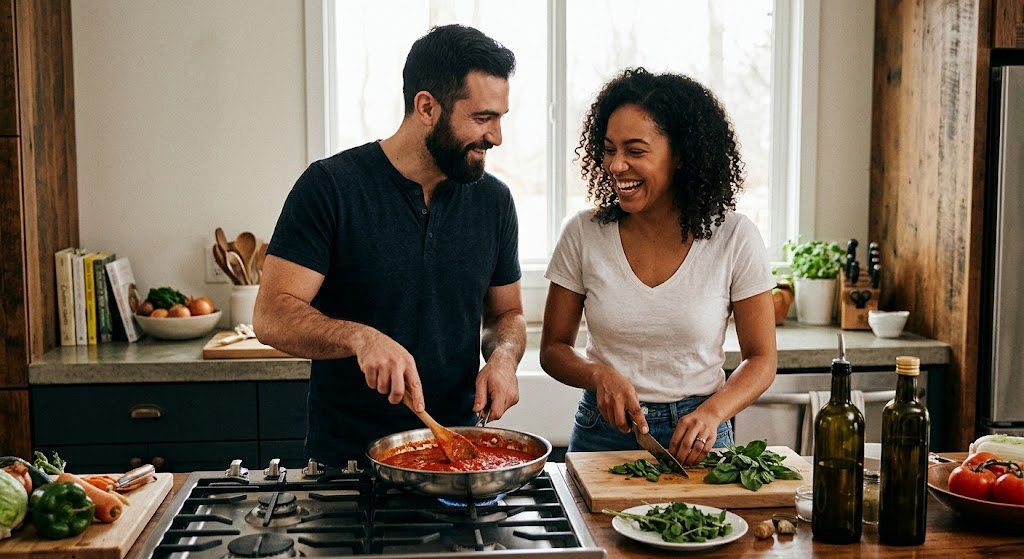
The traditional view often frames cooking as a solitary chore, sometimes falling unevenly on one partner. However, shifting that perspective to co-creation changes everything. Instead of one person “helping” the other, both partners become co-chefs.
This collaboration requires negotiation: Who chops? Who stirs? What temperature do we need? These small decisions build a foundation of subtle coordination. Learning to work in sync—anticipating when your partner needs a utensil or simply a tasting spoon—reinforces teamwork in a low-stakes, highly rewarding environment. It teaches patience, flexibility, and the ability to laugh when things go slightly wrong (which they invariably will).
(Visual Reminder: Insert a detailed close-up image here, showing the couple’s hands actively working together).
(Add Image Block)
- Image Prompt for this section (Place Image 2 here): “A detailed close-up shot focusing on the shared wooden cutting board from Image 1. The husband’s left hand is gently steadying a large bunch of basil, while the wife’s hand, holding a sharp chef’s knife, is actively slicing through the herbs. The light highlights the texture of the basil, the wood grain, and the rings on their fingers. Soft, rustic kitchen background.”
2. Communication Without Words
The kitchen is a loud, active environment. Between the hiss of a searing pan and the rhythm of the knife, verbal communication isn’t always efficient. This is where non-verbal understanding flourishes. Couples who cook together develop an intuitive language: a slight nod of the head, a specific way of offering a pan, or even a shared glance of relief when a complicated sauce is perfected. This kind of physical synchronization is a powerful, silent form of emotional intimacy.
3. The Sensory Experience
Unlike most shared household tasks, cooking is an all-encompassing sensory experience. We connect deeply when we share physical sensations: the smell of garlic sautéing in olive oil, the sight of vibrant fresh vegetables, the feeling of kneading dough, and, ultimately, the taste of the final creation. Sharing these sensory moments together strengthens a unique bond that is both comforting and creative.
(Visual Reminder: Place an image here showing the couple focused on tasting and enjoying the outcome).
(Add Image Block)
- Image Prompt for this section (Place Image 3 here): “A medium-close photograph in the same warm kitchen style as seen in Image 1 and Image 2. The couple is now taking a moment to taste a sample of the tomato sauce. The man is holding a small tasting spoon to his wife’s mouth. She is smiling broadly as she tastes it, holding the wooden spoon she was using to stir. The focus is on their joyful expressions and the interaction. The stove is visible behind them.”
4. Building a Shared Ritual
Perhaps the greatest value of cooking together lies in the creation of rituals. A dedicated “Pasta Night” on Fridays or the complex assembly of a Sunday roast can become anchors in a marriage. These rituals are predictable points of connection, providing a sense of stability and anticipation. The kitchen becomes not just a room for preparing food, but a dedicated space where memories are seasoned and shar